
On the edge of Jinji Lake, where one of China’s most historically layered cities meets its rapidly evolving contemporary skyline, a new cultural landmark has opened its doors. The Suzhou Museum of Contemporary Art (Suzhou MoCA) is more than a new home for exhibitions. Conceived as an architectural landscape of gardens, pathways, water and interconnected pavilions, it proposes a different way of thinking about what a contemporary museum can be.
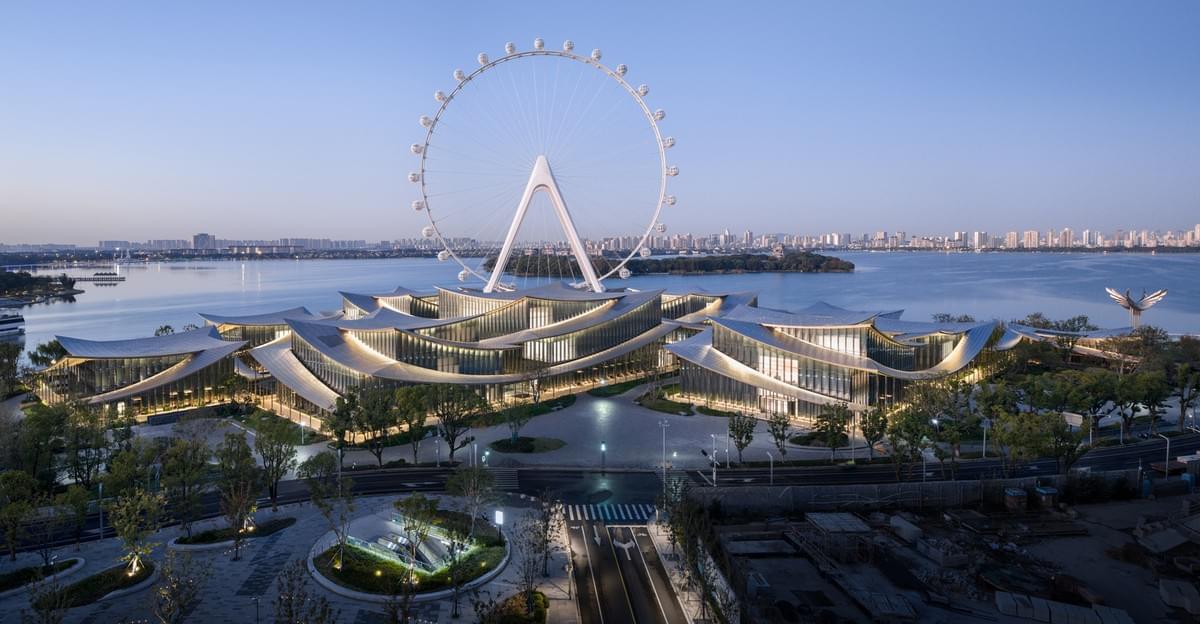
Yet the significance of Suzhou MoCA lies not simply in its scale or architectural authorship. Its deeper story is found in the relationship it establishes between heritage and experimentation, East and West, architecture and landscape, art and everyday public life.
A Museum Inspired by a Garden
Suzhou is internationally celebrated for its classical gardens, carefully orchestrated environments in which architecture, water, rocks, vegetation, corridors and framed views are composed as a continuous experience. Rather than reproducing this tradition literally, BIG translates its spatial logic into contemporary architectural language. At the heart of the concept is the lang (廊), the covered corridor characteristic of traditional Chinese gardens. At Suzhou MoCA, this idea expands into a network connecting exhibition halls, gathering areas, gardens and cultural spaces. Visitors do not simply enter a building, move through galleries and leave. They are encouraged to wander, pause, turn, encounter water, enter another pavilion and rediscover the landscape from a different perspective.
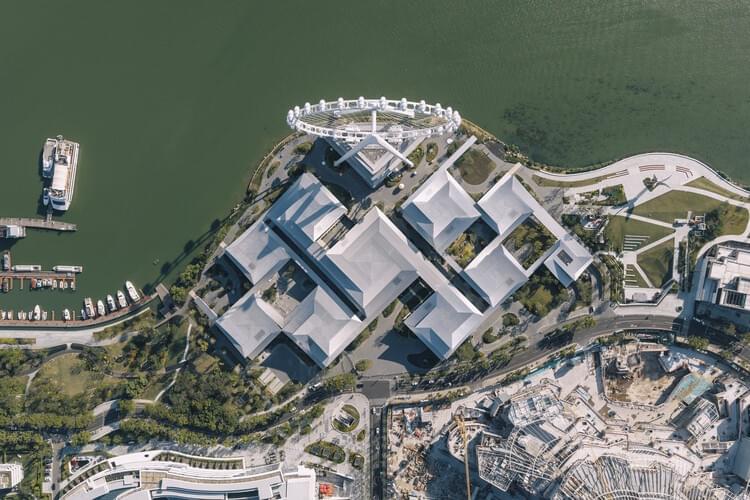
This makes movement itself part of the museum experience. The twelve pavilions are linked through routes, bridges and tunnels, creating a flexible sequence rather than a rigid procession. Smaller paths allow visitors to depart from the principal circulation route and explore different exhibitions and landscapes. It is an architectural idea remarkably suited to contemporary art: there is no single prescribed way of seeing.
Between City and Water
The museum occupies a strategically important position between Suzhou's expanding urban district and Jinji Lake. Rather than placing a monumental object between the city and the waterfront, the architects fragmented the museum into a collection of structures and gardens. The resulting porosity allows public movement through the site and towards the lake. The museum therefore operates simultaneously as an art institution, garden, pedestrian landscape and civic space.
Water penetrates between the pavilions. Sculpture gardens extend through the complex. Reflective façades respond to changing skies and surrounding vegetation. The building alternately appears substantial and almost dissolved into its setting. Its material character reinforces this relationship. Rippled and curved glass is combined with warm-toned stainless steel, allowing the façades to mirror water, landscape and light. The architecture changes according to weather, season and viewpoint rather than presenting a single fixed image.
The Fifth Façade
Suzhou MoCA becomes particularly striking when seen from above. Its ribbon roof loops between the pavilions and around the neighbouring Ferris wheel, producing a form reminiscent of an infinity knot or intricate paper-cut composition. The presence of the Ferris wheel presented an unusual architectural condition: thousands of visitors would regularly view the museum from high above. The roof could therefore no longer be treated as merely the top of the building. It effectively became another façade. BIG Founder and Creative Director Bjarke Ingels has described this elevated perspective as the museum's “fifth facade,” with the architecture transforming into a graphic landscape when viewed from the wheel. From ground level, however, that geometric clarity disappears. The visitor encounters fragments: a garden, a reflective wall, a corridor, water, an exhibition entrance, another courtyard. The architectural diagram becomes an unfolding sensory experience. That contrast between order from above and discovery from within is one of the project's most compelling ideas.
Art Begins Before the Gallery
Traditional museums often separate artwork from the outside world through monumental walls and controlled interiors. Suzhou MoCA challenges that separation. Here, the journey towards an artwork begins in the landscape. Gardens become transitional galleries. Corridors frame views. Water reflects architecture. Movement between buildings creates moments of anticipation before entering another exhibition.
The museum consequently suggests that contemporary cultural architecture need not simply contain art. Architecture itself can establish the conditions through which art is experienced. This is particularly relevant in Suzhou, where gardens historically operate through carefully constructed relationships between what is visible and concealed. A doorway reveals only part of a scene; a corridor delays arrival; a window transforms landscape into a composition. Suzhou MoCA translates these principles into the language of a 21st-century cultural institution.
An Opening Season Across Generations
Architecture provides the framework, but the museum's inaugural programme demonstrates an equally ambitious cultural agenda. Its opening season brings together modern and contemporary art, digital and technology-oriented practices, Chinese artistic developments and cross-cultural conversations. Among its headline presentations is “Picasso and the World of His Influence,” centred around Pablo Picasso's celebrated Vollard Suite. Rather than positioning Picasso in isolation, the exhibition considers the wider reach of his artistic legacy and its relationship to artists working across different regions and generations.
The programme also includes a major presentation of contemporary Chinese art alongside explorations of art and technology. Meanwhile, “BIG: MATERIALISM”, first presented during the museum's preview period, continues within the institution. Through models and large-scale material studies, the exhibition examines ten materials, from stone to recycled matter, and their role in BIG's architectural practice. The juxtaposition is significant. Picasso's printmaking, contemporary Chinese practices, technological experimentation and architectural material research occupy the same cultural ecosystem. Rather than defining contemporary culture through one medium or geography, Suzhou MoCA begins with multiplicity.
A Museum Beyond Its Walls Perhaps the museum's most important ambition is its relationship with the public. The idea of the museum as an isolated cultural monument has gradually been changing internationally. Increasingly, institutions are being asked to operate as places of education, encounter, participation and public life. Suzhou MoCA's architecture appears designed around precisely this shift. Its gardens and circulation spaces blur the distinction between someone who has deliberately arrived to see an exhibition and someone simply moving through the landscape towards Jinji Lake. That accessibility may ultimately prove as important as the building's spectacular form. A contemporary museum becomes culturally meaningful not simply because of the artworks it preserves or displays, but because of the relationships it creates, between artists and audiences, generations and histories, local communities and international perspectives.
The Ancient Future of Suzhou
Suzhou MoCA arrives in a city whose identity has always involved an extraordinary negotiation between culture and landscape. Its architecture does not attempt to recreate a historical Suzhou garden. Nor does it reject tradition in pursuit of an anonymous international modernity. Instead, it extracts an idea from history, the corridor, the pavilion, the framed landscape, the journey through gardens, and asks what that idea might become today. This is where the museum acquires significance beyond architectural spectacle.
The project suggests that cultural heritage need not remain frozen in the past. Tradition can become a methodology: something capable of generating new spatial experiences, new architecture and new forms of cultural exchange. From above, Suzhou MoCA may resemble a continuous knot. From within, it is intentionally less certain. Paths divide. Gardens interrupt architecture. Water enters the composition. Art appears, disappears and reappears. Visitors construct their own routes. And perhaps that is the most contemporary quality of this new museum. Suzhou MoCA does not simply ask visitors to look at art. It invites them to move through a landscape where architecture, nature, heritage and art continuously reshape one another. In a city renowned for turning the garden into an art form, its newest museum proposes that the museum itself can become a garden.
SUZHOU MoCA | AT A GLANCE
Institution: Suzhou Museum of Contemporary Art
Location: Jinji Lake, Suzhou, Jiangsu Province, China
Public Opening: 30 August 2026
Area: 60,000 m² Architecture: BIG – Bjarke Ingels Group
Collaborating Design Teams: ARTS Group, VIA.inc and SHUISHI
Architectural Composition: 12 interconnected pavilions
Design Inspiration: Suzhou's classical garden tradition and the *lang* (廊), or covered garden corridor
Significance: BIG's first completed art museum
Programme: Contemporary and modern art, Chinese and international practices, art and technology, architecture, education and public cultural programmes.