
An evocative journey through sand, forgotten games and the fragile beauty of childhood memories at Rizq Art Initiative, Abu Dhabi
There is something extraordinary about the way childhood remains within us. A familiar object, the texture of sand between our fingers, the sound of bursting bubble wrap or the sight of an ordinary plastic chair can suddenly transport us to a world we thought we had left behind. Memories return unexpectedly, sometimes clear and comforting, sometimes incomplete and strangely unfamiliar.
In What We Left in the Sandbox, Emirati artist Reem Al Mubarak transforms these delicate fragments of childhood into a deeply personal yet universally relatable artistic experience. Presented at Rizq Art Initiative in Abu Dhabi, the exhibition explores the relationship between memory, identity, play and the objects that quietly carry our stories.
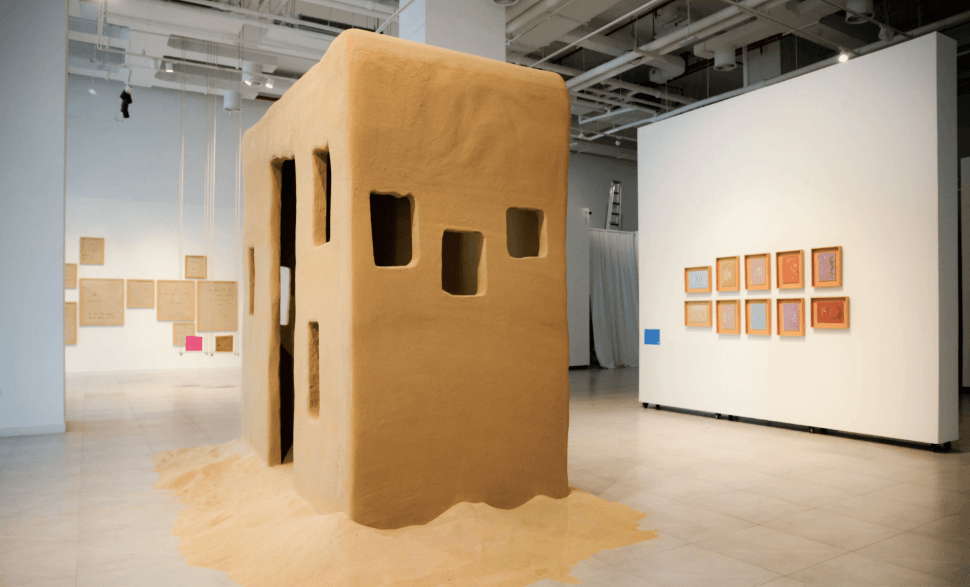
Gallery View - Reem Al Mubarak's What We Left in the Sandbox Courtesy: the artist and Rizq Art Gallery
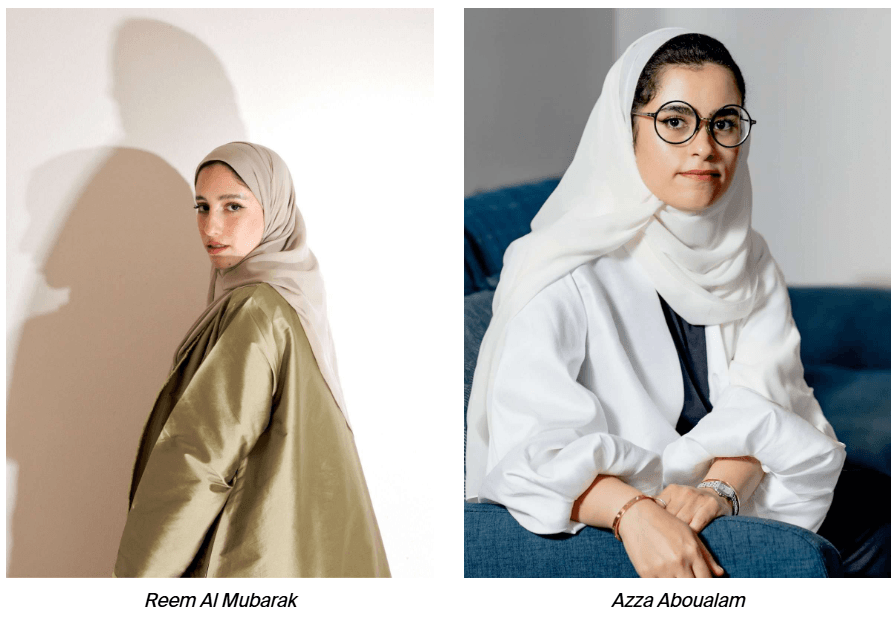
Curated by Emirati architect and researcher Azza Aboualam, the exhibition moves beyond conventional gallery presentation. It invites visitors to enter an imaginative landscape where sand becomes architecture, childhood games become reflections on life, and ordinary objects reveal unexpected emotional meanings. This exhibition is about remembering childhood. It is an exploration of how memories are created, reshaped and sometimes reinvented as we grow older. What makes the exhibition particularly compelling is its ability to turn something deeply personal into a shared experience. Reem's memories may provide the starting point, but the artworks gradually become mirrors in which visitors can recognise fragments of their own lives.
At the heart of the exhibition stands an extraordinary sandcastle inspired by Reem Al Mubarak's childhood home. Its towering walls, oversized doorway and exaggerated proportions recreate the way a familiar house might appear through the eyes of a small child. The installation is both playful and quietly profound. As children, the world often seems larger than life. Doorways appear enormous, rooms feel endless and even the smallest spaces become landscapes of adventure. Returning to those same places as adults can reveal how dramatically our perception has changed. Reem captures this transformation through scale, material and architectural imagination.
The sandcastle does not attempt to reproduce her childhood home with historical accuracy. Instead, it represents the house as she remembers it, complete with the distortions and uncertainties that time introduces. Surrounding the central structure are smaller sand houses, some suspended like swings, repeating architectural details that the artist can only partially recall. Windows, doors and familiar forms become elements of an ongoing attempt to reconstruct a place that now exists primarily in memory. The repetition raises an intriguing question: when we repeatedly recreate a memory, are we recovering the past or constructing a new version of it? Here, architecture becomes an emotional language. The house is no longer merely a building; it becomes a symbol of belonging, family, childhood and the passage of time.
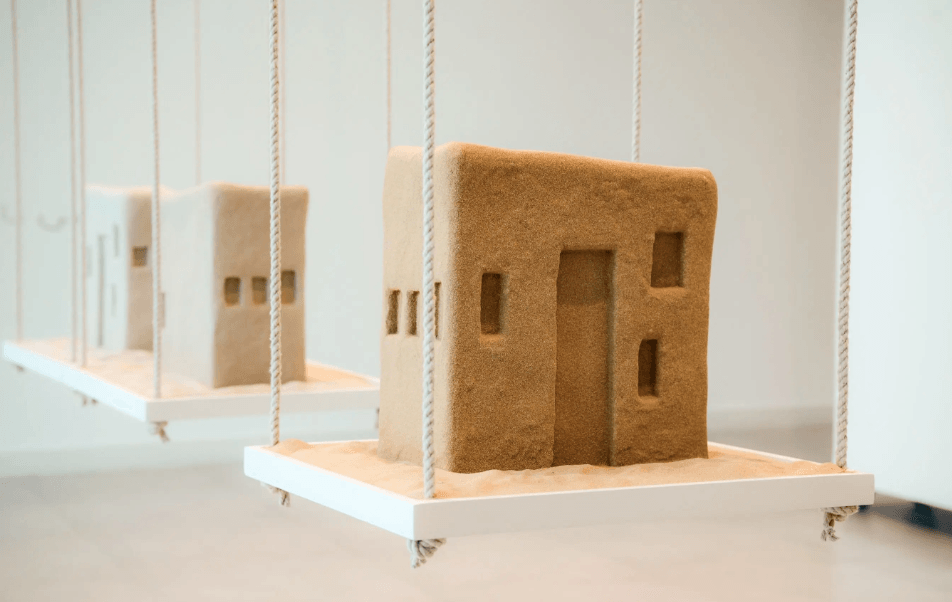
Gallery View - Reem Al Mubarak's What We Left in the Sandbox Courtesy: the artist and Rizq Art Gallery
Sand plays a central role throughout the exhibition, functioning as both artistic material and conceptual foundation. Before developing these works, Reem spent approximately a year researching sand from different locations across the UAE. She collected samples, studied their composition and explored variations in colour, texture and formation. The resulting palette reflects the country's diverse landscapes: pale sands associated with Saadiyat, warmer yellow tones from Abu Dhabi and reddish shades influenced by the mineral-rich sands of Al Ain. This research introduces a fascinating connection between personal memory and geographical identity.
Sand is one of the most familiar elements of the UAE's natural environment. It belongs to beaches, deserts, playgrounds and family landscapes. Yet it is also constantly shifting, shaped by movement, time and natural forces. In Reem's work, this instability becomes a powerful metaphor for memory itself. A grain of sand may appear insignificant, but countless grains can form an entire structure. Similarly, small moments and seemingly ordinary experiences accumulate to shape our understanding of who we are. The material also carries an inherent contradiction. Sand is associated with impermanence, yet the artist uses it to reconstruct places and experiences she wishes to preserve. This tension between permanence and disappearance gives the exhibition much of its emotional depth.
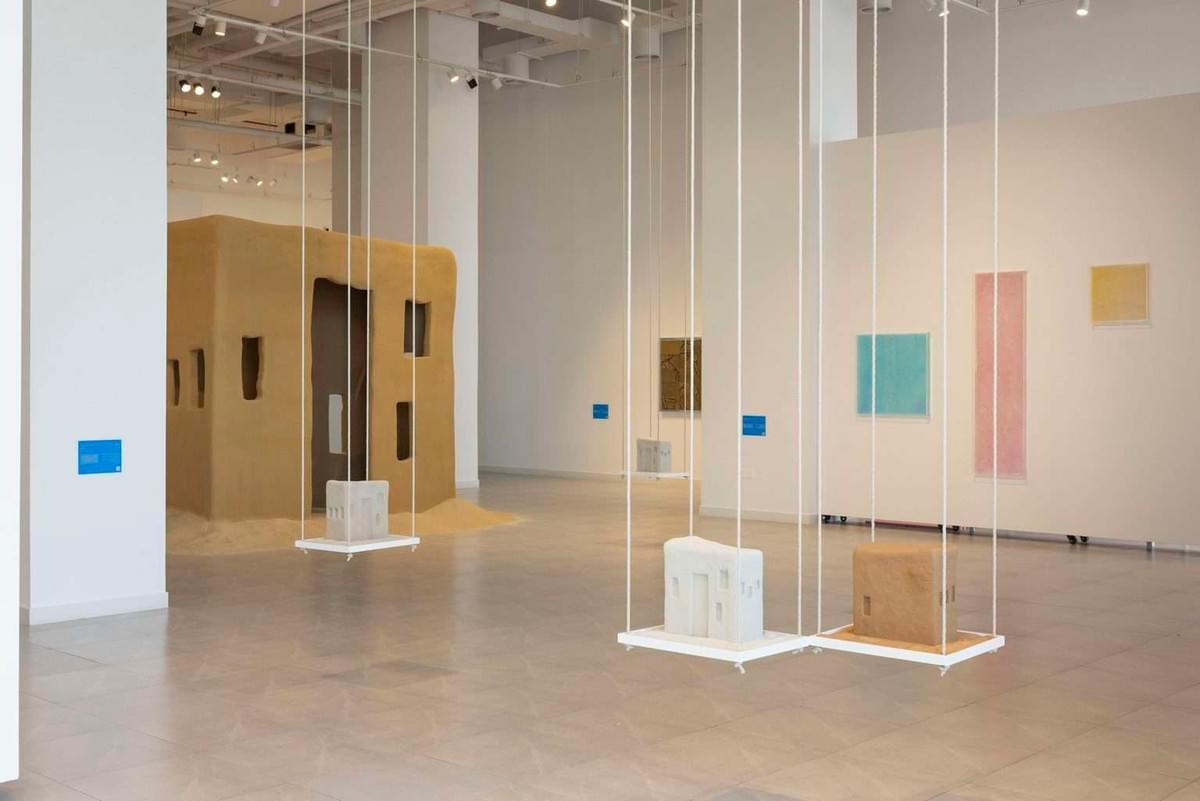
Gallery View - What We Left in the Sandbox by Reem Al Mubarak. Curated by Azza Aboualam Courtesy: the artist and Rizq Art Gallery
One of the exhibition's most engaging qualities is its transformation of ordinary childhood objects into meaningful artistic expressions. Bubble wrap, plastic chairs, sliding puzzles and familiar games become instruments through which Reem examines memory, imagination and human connection. In a series of works incorporating bubble wrap, the artist draws inspiration from childhood experiences shared by others. A bicycle leaves a trail of burst bubbles, while other compositions reflect the familiar pleasure of pressing each small pocket of air. These works remind us that childhood happiness often came from the simplest discoveries. The bubble wrap is not merely a material. It becomes a record of action, sound and fleeting enjoyment.
Equally fascinating is the series We Never Used Them Properly, which reimagines the familiar white plastic chair. For adults, a chair is generally a practical object designed for sitting. For children, however, it can become almost anything: a stage, a fort, a vehicle, a climbing structure or part of an imaginary kingdom. Reem recreates these chairs through aluminium and reflective surfaces, transforming an everyday household object into something sculptural and contemplative. As visitors approach, their reflections become part of the artwork. This interaction introduces an important shift. The viewer is no longer simply observing the artist's memories but is physically included within them. The chair becomes a meeting point between the artist's childhood and the visitor's own experiences.
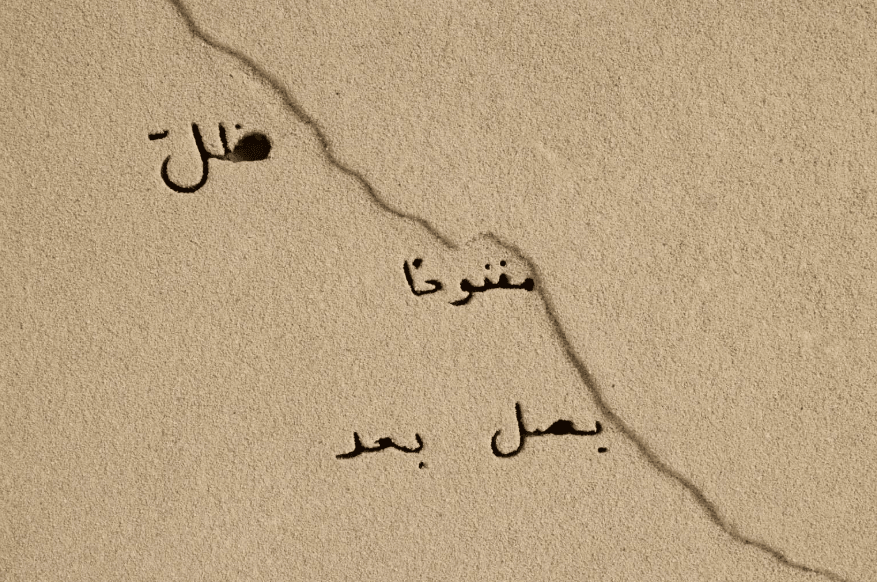
I Remember What Comes After This, Sand by Reem Al Mubarak, Courtesy: the artist and Rizq Art Gallery
Among the exhibition's most emotionally resonant works is Call Me That Again, a metal sliding puzzle inspired by a childhood memory involving Reem's grandfather. As a child, he affectionately called her Freyha, meaning "the happy one." The memory of this relationship remains deeply meaningful, yet the exact details of certain moments have become difficult to reconstruct. Reem translates this emotional uncertainty into a physical puzzle based on a family photograph. Visitors are invited to move the heavy metal pieces and attempt to assemble the image. However, one piece remains fixed, making it impossible to complete the picture perfectly. The simplicity of this concept carries considerable emotional weight. Memory rarely returns as a complete image. We remember a voice but forget the exact words. We recall a place but struggle to reconstruct its dimensions. We hold onto feelings long after the details surrounding them have faded. The incomplete puzzle becomes a poetic representation of this experience.
Its strength lies in the fact that the viewer can understand the idea not only intellectually but physically. The act of trying to complete the image, while knowing that perfect reconstruction is impossible, transforms an abstract idea into a tangible experience. The artwork suggests that remembering is not always about recovering every missing detail. Sometimes, the emotional truth of a memory remains even when its original form has disappeared.
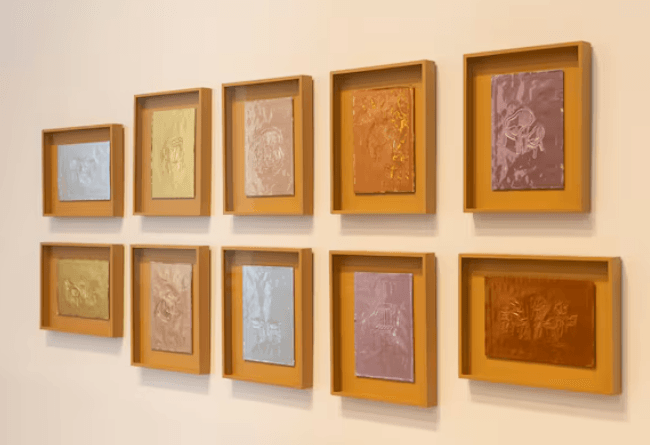
Aluminium Impressions by Reem Al Mubarak. Courtesy: the artist and Rizq Art Gallery
Childhood games provide another important layer within the exhibition. Through works inspired by tic-tac-toe, Reem reflects on how our understanding of winning, losing and relationships changes with age. One work recalls the competitive excitement of childhood, when winning a simple game could feel like a major achievement. Another draws inspiration from a game played with her young niece, when the artist realised that allowing a child to experience the joy of winning could be more meaningful than claiming victory herself. The contrast is subtle but deeply human.
As children, we often measure success through winning. As adults, we begin to recognise the value of kindness, generosity and the happiness of others. What initially appears to be a familiar childhood game becomes a reflection on emotional growth and changing perspectives. Other works, including partially erased poetry, suspended houses and delicate architectural forms, continue this exploration of memory as something unfinished, layered and constantly evolving.
The curatorial approach of Azza Aboualam is essential to the exhibition's identity. An Emirati architect, researcher and academic, Aboualam brings an architectural understanding of space, movement and human interaction to the presentation. Her previous achievements include becoming the first Emirati woman to curate the UAE National Pavilion at the Venice Architecture Biennale in 2025. For What We Left in the Sandbox, she has created an exhibition environment without a fixed visitor route. Rather than directing audiences through a predetermined sequence, the gallery encourages exploration, discovery and personal interpretation. Visitors encounter artworks from different perspectives, move between installations and engage with selected materials and interactive elements. This approach reflects the unpredictable nature of memory itself.
We rarely remember our lives in chronological order. A single image may lead to an unrelated experience, while an ordinary object can suddenly awaken a forgotten emotion. The exhibition's spatial arrangement mirrors this process, allowing memories to emerge through movement and association. Aboualam's contribution is particularly effective because the architecture of the exhibition becomes inseparable from the artworks. The gallery is transformed into a playground of recollection, where the relationship between artist, object and audience remains open and fluid.
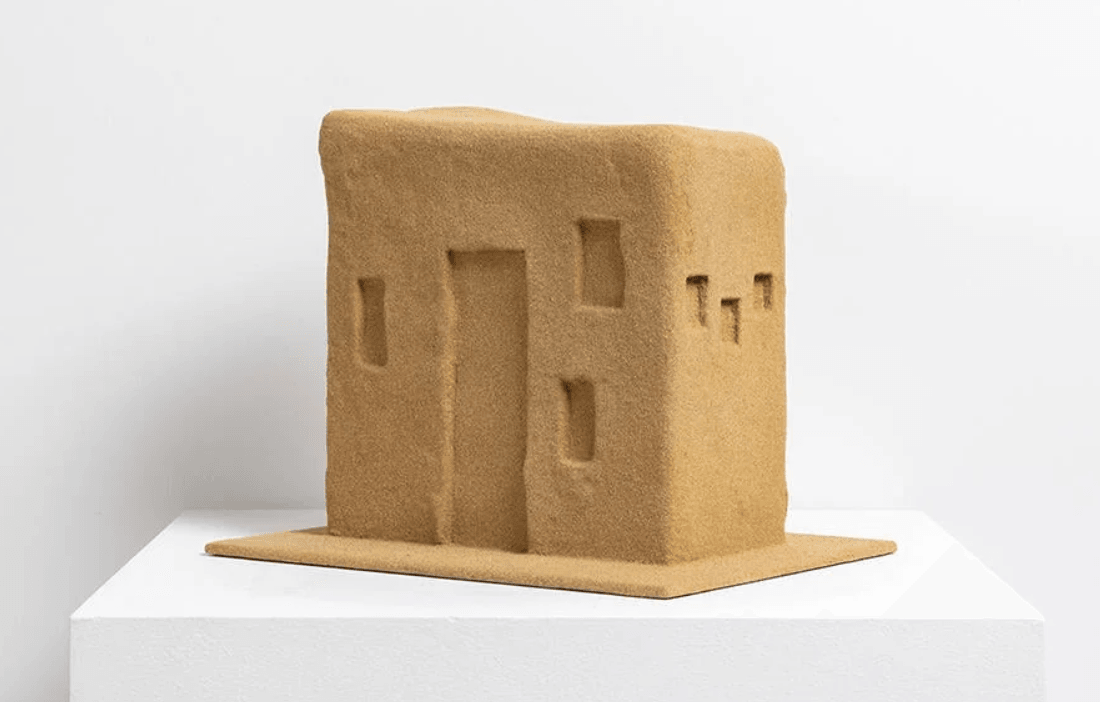
Reem Al Mubarak, It Fell, So I Made Another, 2026, sand, 30 × 30 × 15 cm. Courtesy: the artist and Rizq Art Gallery
The collaboration between Reem Al Mubarak and Azza Aboualam also represents an important moment for contemporary Emirati artistic practice. Both women approach creativity through research, experimentation and a strong connection to the UAE's cultural environment. Reem, an artist, author and founder of Studio Untitled, the UAE's first female-only art studio, works across sculpture, poetry and unconventional materials. Her practice often explores the relationship between personal experience, collective identity and artistic expression. The exhibition, her second solo presentation and largest to date, developed partly through a six-month residency at Abu Dhabi's Cultural Foundation.
Azza's background in architecture and research brings another dimension to these investigations, particularly in the way physical environments influence memory and social experience. Together, they demonstrate how contemporary art can move beyond conventional categories, bringing sculpture, architecture, poetry, research and audience participation into a shared creative language. Their collaboration also reflects the growing confidence and diversity of women-led artistic practices within the UAE. Perhaps the most beautiful aspect of What We Left in the Sandbox is the way it transforms individual memories into collective experiences.
Although many of the artworks emerge from Reem's personal childhood in Abu Dhabi, their emotional language reaches beyond geography, nationality and generation. Almost everyone remembers building something that did not last, inventing games from ordinary household objects or experiencing the uncomplicated happiness of childhood. These shared experiences allow visitors to connect with the artworks through their own histories. The exhibition does not demand that audiences understand every reference or uncover every personal detail. Instead, it leaves room for imagination. A visitor may see a plastic chair and remember a family gathering. Another may encounter bubble wrap and recall a childhood gift. Someone else may stand inside the sandcastle and remember a home that no longer exists. In this way, the exhibition becomes a collection of overlapping memories, continuously expanded by those who experience it.
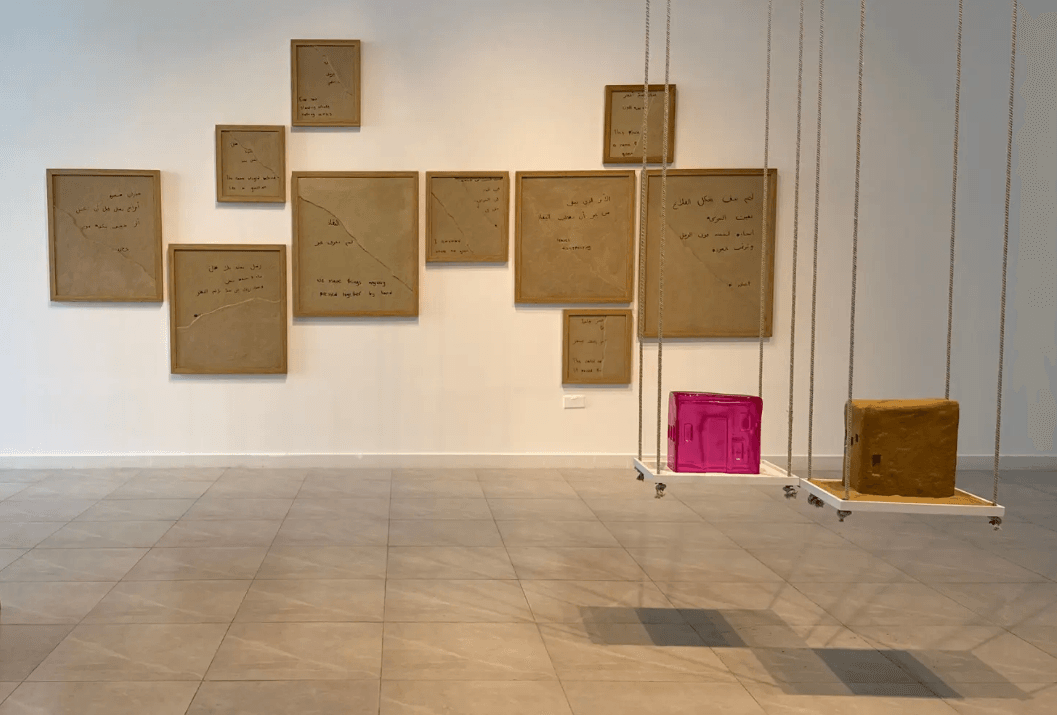
What We Left in the Sandbox, Gallery View - Reem Al Mubarak, Courtesy: the artist and Rizq Art Gallery
Art4you Magazine Review:
What We Left in the Sandbox succeeds through its sensitive balance of artistic experimentation, material research and emotional storytelling. Its strongest quality is the use of unusual materials or the scale of its installations, but the thoughtful relationship between concept and experience. The oversized sandcastle captures the distortion of childhood perception. The incomplete puzzle communicates the impossibility of fully reconstructing memory. The reflective chairs introduce the viewer into the artwork, while familiar games reveal how emotional values change over time. Each work offers a different way of approaching the same central question: how do we carry our childhood into adulthood, and what happens to the memories we leave behind?
Reem Al Mubarak's artistic language is playful without becoming superficial and personal without excluding the audience. Her material choices give physical form to experiences that are often difficult to describe. Azza Aboualam's spatial curation strengthens this approach, creating an environment where visitors are encouraged to discover rather than simply observe. There is also a meaningful connection between the exhibition and its location in Abu Dhabi. Through the use of local sand, familiar domestic objects and memories of the city's changing landscapes, the project quietly documents aspects of everyday Emirati life that may otherwise remain outside traditional historical narratives.
Rather than presenting heritage as something distant or monumental, it finds cultural meaning in ordinary experiences. This makes the exhibition especially relevant within contemporary discussions about memory, identity, material culture and the relationship between art and lived experience.
There is a quiet poetry in the title What We Left in the Sandbox. A sandbox is a place where children build worlds without worrying about their permanence. Castles collapse, drawings disappear and games eventually end. Yet the imagination, happiness and relationships associated with those moments remain with us. Reem Al Mubarak returns to this symbolic space not to recreate childhood exactly as it was, but to explore what survives after time has changed our understanding of it.
The exhibition reminds us that memory is a living process shaped by emotion, imagination, absence and the stories we continue to tell ourselves. Through sand, sculpture, familiar objects and interactive experiences, the artist offers a gentle invitation to reconnect with the curiosity that adulthood often leaves behind. Perhaps the most meaningful things we leave in the sandbox are not the castles we built or the games we played, but the feelings that continue to shape us long after childhood has passed. And sometimes, all it takes is a handful of sand, an unfinished puzzle or an ordinary plastic chair to bring those feelings back.
Exhibition Information
Exhibition:What We Left in the Sandbox
Artist: Reem Al Mubarak Curator:Azza Aboualam
Venue: Rizq Art Initiative, Leaf Tower, Ground Floor, Al Reem Island, Abu Dhabi, UAE
Dates: 6 November 2026 – 10 January 2027 Opening Hours: Tuesday–Sunday, 11:00 AM–7:00 PM
Admission: Free entry Audience: All ages
Editorial Note: This exhibition review is based on published exhibition information, artist and curator interviews, and available documentation. It is a critical editorial interpretation rather than a firsthand account of a gallery visit.