
Sharjah: At Sharjah Art Foundation’s Photography Gallery, six artists stretch documentary photography beyond the act of recording, turning the image into a space for memory, belonging, absence and lived experience.
There is a particular expectation we carry into a photography exhibition: that the photograph will show us something. A person, a place, an event, perhaps a reality we have never encountered ourselves. Vantage Point 13 asks for something more. Walking through the exhibition at Sharjah Art Foundation’s Photography Gallery in Al Manakh, it becomes apparent that these photographs are not simply asking to be seen. They ask to be considered, revisited and, in some cases, questioned.
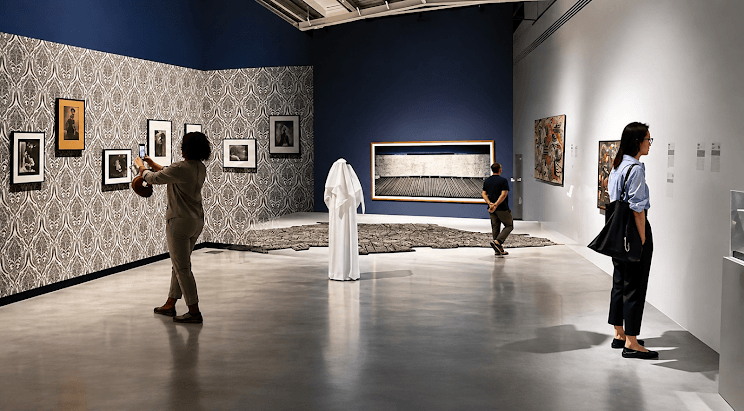
What are we really looking at when we look at a photograph? A record of what happened? A fragment of someone’s memory? An interpretation shaped by the person behind the camera? Or an image whose meaning changes according to the history and experience we bring to it? These questions quietly follow the visitor through the thirteenth edition of Vantage Point.
Bringing together newly commissioned bodies of work by Luisa Dörr, Latifa AlBokhari, Sathish Kumar, Adam Rouhana, Guanyu Xu and Maheder Haileselassie, the exhibition explores documentary photography at a moment when the idea of photographic “truth” has become increasingly complicated. Curated by Sara Al Mheiri, Assistant Curator, and Osemudiamen Ekore, Curatorial Assistant at Sharjah Art Foundation, Vantage Point 13 does not attempt to define documentary photography. Instead, it demonstrates just how expansive the field has become.
Beyond the Documentary Image
One of the most compelling qualities of the exhibition is the absence of a single visual language. There is portraiture and observation, but there are also collage, installation, archival material, enlarged images and constructed environments. Some photographs feel immediately intimate; others require distance. Some invite us into communities and domestic spaces, while others deliberately remind us of what cannot easily be seen or recovered.
This diversity is important. Documentary photography has historically carried an association with evidence, the idea that the camera records what stands before it. Yet every photograph is also an act of selection. Someone decides where to stand, when to press the shutter, what remains inside the frame and what disappears beyond it.
Vantage Point 13 seems particularly conscious of this tension. Across the exhibition, documentation becomes less about establishing a definitive truth and more about examining how realities are represented, remembered and inherited. It is here that the six practices begin to connect.
Land, People and the Intimacy of Observation
In the works of Luisa Dörr, Latifa AlBokhari and Sathish Kumar, photography develops through closeness, to people, communities, places and personal histories.
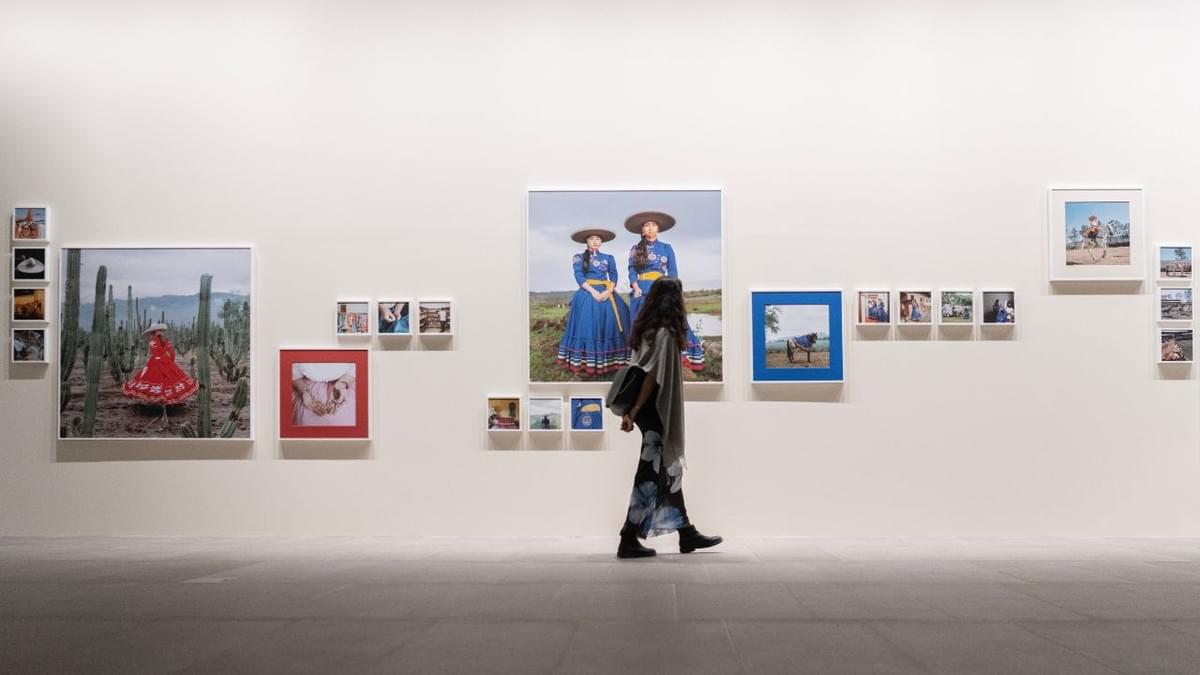
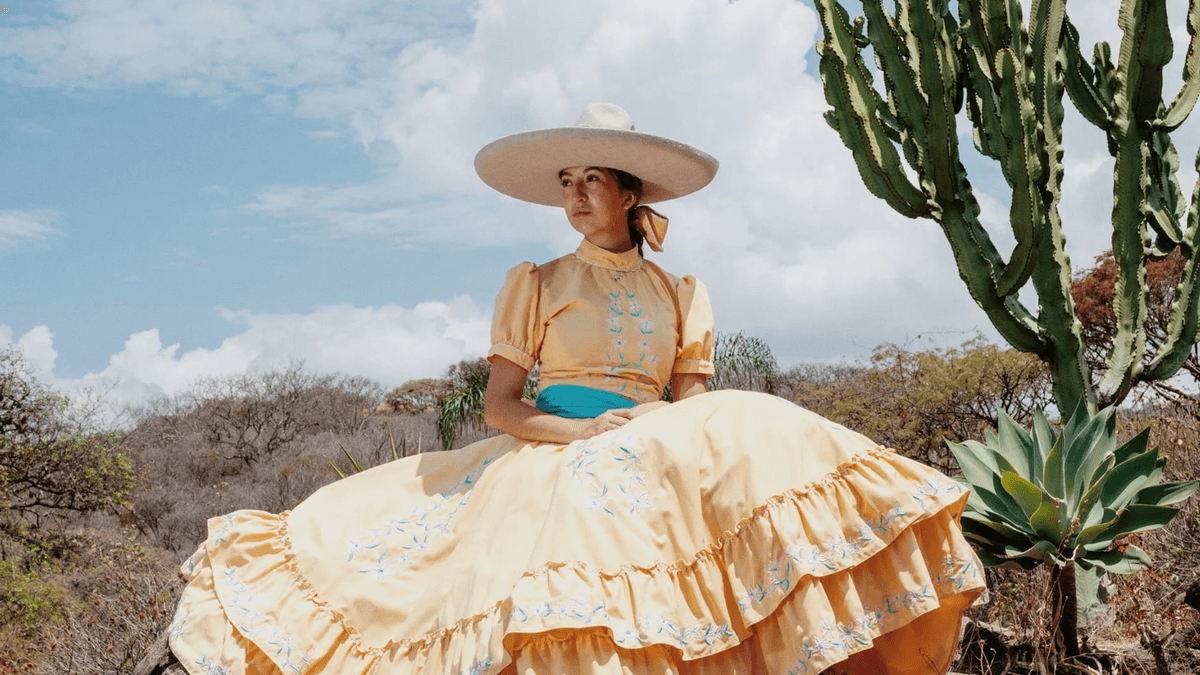
Brazilian photographer Luisa Dörr has long centred women within her photographic practice, and her presentation here demonstrates the power of portraiture when allowed to accumulate. Seen individually, a portrait offers a moment of encounter: an expression, a gesture, a garment, the surroundings of a life. But as more than 30 photographs begin to occupy the viewer’s field of vision, individual stories gradually form something larger.
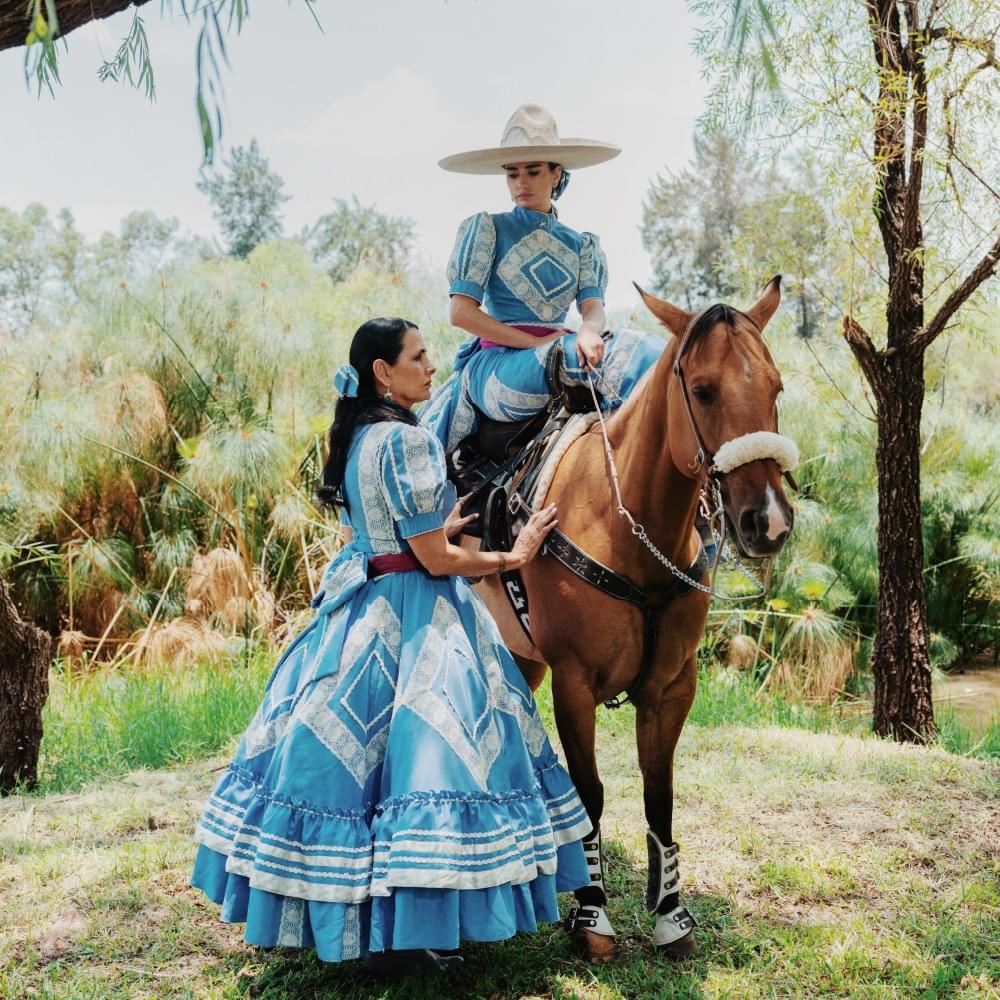
Luisa Dörr, Zoila and Iuzkani, Teuchitlán, Jalisco, Mexico, 2024. From ‘Escaramuzas’, 2024–ongoing.
The strength is not simply in the faces being photographed, but in the relationships between them. The images begin to suggest community, tradition and continuity. The portrait is no longer only about the person standing before the camera; it becomes a way of understanding the social and cultural worlds surrounding her.
Saudi multidisciplinary artist Latifa AlBokhari approaches photography through a similarly intimate relationship with her subjects, but with a strong sensitivity towards inherited memory, family histories and ritual. Her use of analogue photography reinforces the sense of time embedded within the work. Particularly striking is the material presence of photographs printed on velvet. From a distance, they may initially register as images; closer inspection reveals a surface with its own softness, weight and associations.
That material choice changes the encounter. Memory, after all, is rarely smooth or purely visual. We remember through objects, textures, stories, homes, gestures and things passed from one generation to another. In AlBokhari’s work, the photograph begins to behave almost like one of those inherited objects.
For Indian photographer Sathish Kumar, memory operates through another register: the everyday. His photographs emerge from personal experience, including his movement from his hometown of Kanchipuram to Chennai. Rather than searching for spectacle, his attention rests on ordinary moments and details that might easily pass unnoticed.
This produces some of the exhibition’s quieter encounters. A single photograph may appear understated, yet when the images are experienced together, relationships begin to surface. One scene recalls another. Details repeat. A visual rhythm develops. It is a reminder that memory is often built not from extraordinary events but from countless ordinary ones.
When Absence Enters the Frame
Elsewhere in Vantage Point 13, the atmosphere shifts. With Adam Rouhana, Guanyu Xu and Maheder Haileselassie, photography becomes entangled with absence, displacement, visibility and histories marked by rupture. Palestinian-American photographer Adam Rouhana offers an important challenge to familiar ways Palestine has been pictured internationally. Rather than allowing conflict to become the only visual vocabulary through which Palestinian identity is understood, Rouhana turns toward everyday life, children, families, landscapes, gatherings and ordinary human gestures.
That choice carries considerable weight. Images can reinforce dominant narratives, but they can also resist them. By photographing life from within rather than reproducing an external gaze, Rouhana restores complexity to people and places too frequently reduced to political imagery. The ordinary becomes significant precisely because it has so often been excluded. His photographs ask us to consider not only what is visible, but who has historically controlled visibility.
Home as a Constructed Memory
The work of Chinese artist Guanyu Xu changes the physical and psychological rhythm of the exhibition again. Xu works across photography, installation and collage, transforming spaces before photographing them. Family photographs, self-portraits, magazine imagery, archival material and other visual fragments occupy domestic environments until the room itself appears saturated with images.
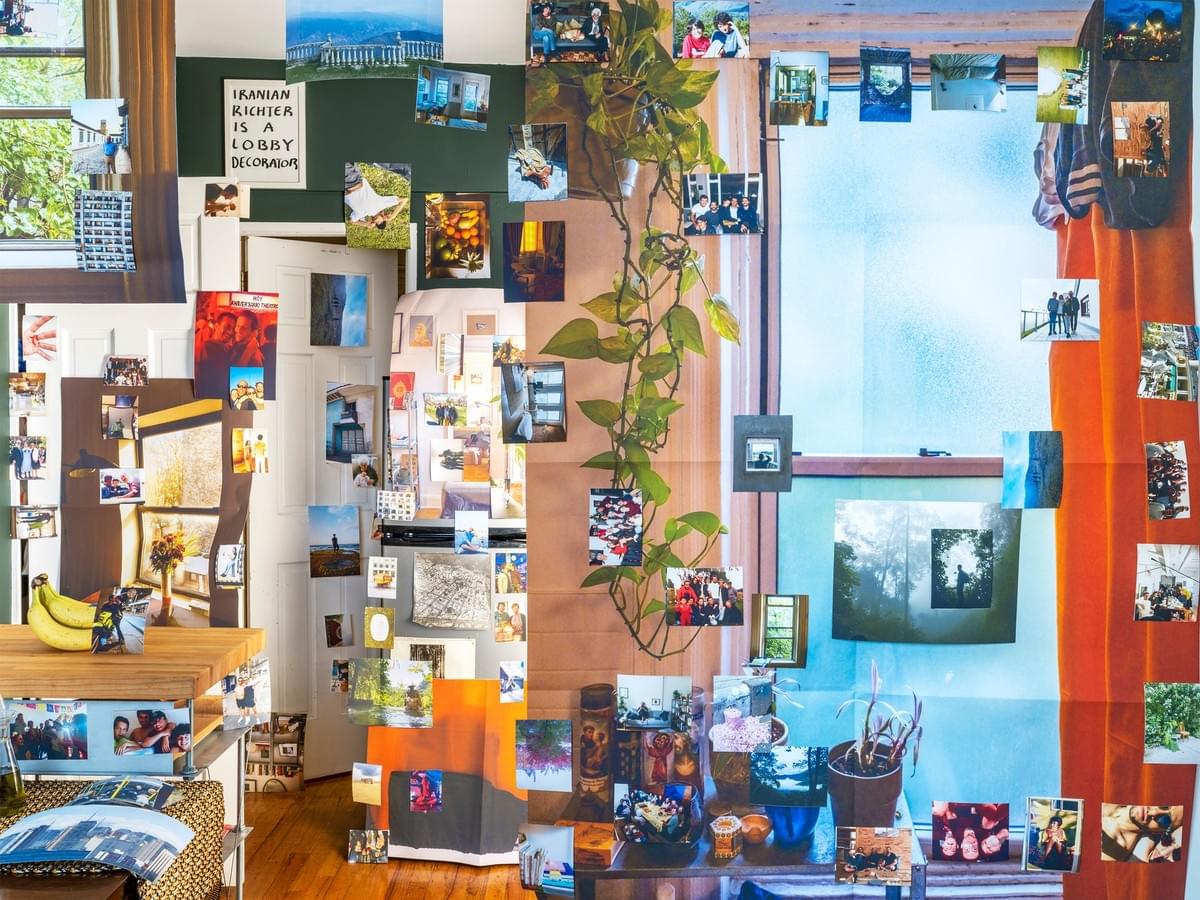
Resident Aliens by Guanyu Xu
The effect is dense and deliberately layered. There is no immediate way to absorb everything. The eye travels across walls, furniture, bodies and photographs within photographs. Images overlap with other images; private histories meet public representations. What initially appears visually overwhelming gradually begins to reveal small clues about identity, migration, family relationships and belonging.
Xu’s work rewards patience. Spend longer with it and the photograph begins to function less like a window and more like an archaeological site, something that must be slowly read. Here, home is not merely an architectural space. It is constructed from memory, desire, cultural expectation and accumulated images of who we were, who we are and how we have been seen.
Can a Photograph Contain a Person?
Among the exhibition’s most conceptually intriguing gestures is Maheder Haileselassie’s engagement with passport photographs. The Ethiopian artist draws together personal memory, archival investigation and collective history, often allowing uncertainty to remain part of the work rather than resolving it.
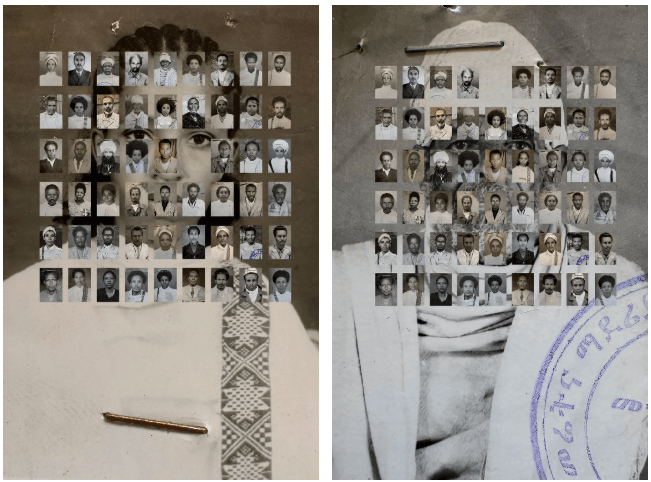
Work by Maheder Haileselassie
The passport photograph is an especially powerful starting point. Few photographic formats are more controlled. Its dimensions, pose, background and expression are dictated by bureaucratic requirements. Its purpose is identification: to confirm that this face corresponds to this person.
Haileselassie disrupts that certainty. By enlarging passport images and removing them from their administrative function, she changes the way they can be read. What was designed as a small piece of identification becomes something unexpectedly intimate. A face once intended to prove identity begins instead to raise questions about it. How much of a person can an official image contain? What histories remain invisible behind that face? And what happens when a photograph survives while parts of the story surrounding it disappear? The simplicity of the source material makes these questions particularly resonant.
Photography Steps Off the Wall
Vantage Point 13 also succeeds because it considers not only what a photograph communicates but how we physically encounter it. This is the first edition of Vantage Point presented in Sharjah Art Foundation’s dedicated Photography Gallery, and the move feels significant. Large-format photographs, constructed installations and spatial interventions allow photography to move beyond the conventional framed image. Scale changes the relationship between viewer and subject. Materials demand closer observation. Installations ask the body to move around and through photographic narratives.
At times we step closer to investigate a detail; elsewhere, we move backwards to understand an image as a whole. That physical movement becomes part of the viewing experience. It also reflects the exhibition’s broader proposition: contemporary documentary photography is no longer restricted to witnessing the world from a distance. It can reconstruct, intervene, question and occupy space.
Six Practices, One Continuing Question
Despite the very different cultural and geographic contexts represented, Vantage Point 13 never feels like six unrelated presentations placed under one roof. Connections emerge gradually.
Memory passes through several bodies of work, but never in quite the same way. For one artist it may be familial; for another political, geographical or archival. Land becomes both physical territory and emotional inheritance. Portraiture becomes an encounter between photographer and subject. Absence becomes something that can paradoxically be made visible. And throughout it all runs the question of representation.
Who creates the image? Who is being represented? Who is looking? And what changes when a photograph moves from one context into another?
The exhibition does not answer these questions, and it is stronger for refusing to do so.
A Platform That Has Learned to Slow Down
Since its launch in 2013, Vantage Point has developed from a regional photography initiative into an international platform supporting photographers at different stages of their practices. Its evolution is particularly evident in this edition.
Rather than presenting a larger survey of photographers, Vantage Point 13 concentrates on six artists, giving each considerably more room to develop and articulate a body of work. The projects were developed through sustained curatorial dialogue and production support, allowing ideas to evolve beyond an initial submission.
That shift from simply selecting photographs to supporting the creation of photographic projects gives the exhibition greater depth. It also reflects Sharjah Art Foundation’s wider approach to contemporary artistic practice: creating structures in which artists are given time, space and institutional support to experiment.
The Image After the Image
Perhaps the most lasting impression of Vantage Point 13 comes after leaving the gallery. Certain images remain, but so do the questions surrounding them. We live within an extraordinary volume of photography. Images are produced, uploaded, circulated and forgotten at a speed previous generations could hardly have imagined. Yet increased visibility has not necessarily produced greater understanding.
Vantage Point 13 slows that process down. It reminds us that a photograph is never merely what appears inside its borders. Around every image exists another invisible frame, history, authorship, power, trust, memory, culture and circumstance.
To look carefully, therefore, is not simply to observe. It is to ask what came before the image, what remains outside it and whose story is being carried forward through it. That may ultimately be the strength of this thirteenth edition. Vantage Point 13 does not present documentary photography as a window onto an unquestionable reality. It presents photography as an active participant in the creation of meaning. And in doing so, it asks the viewer to become one too.
Exhibition: Vantage Point 13
Dates: 8 August – 29 November 2026
Venue: Photography Gallery, Al Manakh, Sharjah, UAE
Presented by: Sharjah Art Foundation
Curated by: Sara Al Mheiri and Osemudiamen Ekore
Participating artists: Luisa Dörr, Latifa AlBokhari, Sathish Kumar, Adam Rouhana, Guanyu Xu and Maheder Haileselassie.
By Noura Hamed | Art4you Magazine | Exhibition Feature | August 2026